
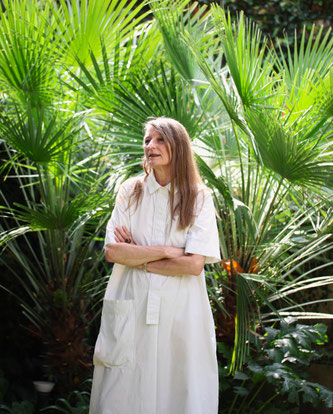
Pia Andell is a Finnish filmmaker, a profession she has had for over 30 years. In May 2026, she spent her third time in Rome and her second time at Circolo. A lot of things have changed. Last time she was here, Circolo was situated at Trastevere, the pandemic did not yet exist in people’s consciousness and the mass tourism after COVID and the jubilee had not occurred. The city is changing, yet a lot stays the same.
‘I just learned when I went to Ostia Antica that the oldest known Synagogue was located there. So, Rome was a hot spot for everyone all over. And now that is the case once again.’
Pia’s path to filmmaking did not follow a straight line. She started in acting, then changed to the study of religions, then to journalism. During her journalism education in Tampere, they mostly focused on working with print, and Pia longed for pictures. She therefore moved on to filmmaking to expand her knowledge further. At that time, documentary filmmaking was not a well-known concept, nor a profession. Only a few people in Finland were doing it full-time.
‘I do remember the moment when I realised that I do not have a skill, but I can do fairly well in many areas. Because in film, you need to be good with people, you need to have a visual sense of style, and you have to build narration and so on. Different skills where I am not perfect, but I have some knowledge… And it is true that my background helps me with the research work, but usually there is often a notion that you want to find out, and a question that you want to answer.’
Pia was selected to make a short film for a TV channel, in which the participants were to create a 30-minute movie. From the TV program, she got to know the producer of the show, and together they continued making projects, with Pia as the director. Later on, Pia created her own production company, ‘Of Course My Films’ in 2004 and has since then produced, directed and written the scripts for her films.
Making fiction, versus making documentaries, has its different challenges. Pia describes how fiction is easier in the sense that the filmmaker creates scenarios and characters that can be adjusted and transformed, while with documentary filming, you are representing a story. Although documentaries allow scripts and scenarios too, it is far more unpredictable, making it challenging and intriguing at the same time. After she had produced and made several documentaries, Pia felt that she needed a break and turned to fiction. During her time at Circolo Scandinavo, she has been writing the script for the last part of her trilogy. The films involve the same characters throughout the trilogy, but unfold different issues in different stages of life. The second part, ‘Let’s not Ruin the Party by Talking about Death’ premiered at the Midnight Sun festival in Sodankylä, a beloved and well-recognised film festival in northern Finland.
Alongside her script, Pia has been ideating another project. Her godmother, a passionate amateur filmmaker who lived in Turku, captured a big part of her life through her film camera. All her
observations resulted in multiple boxes filled with 8mm film. After her godmother’s passing, Pia received a phone call where she found out that all the films were bequeathed to her. If she did
not want it, it would go to the trash. The 8 mm films not only visualise a city from a different time, but also demonstrate the first wave of amateur filmmakers. Something that is taken for
granted today was something unique at the time, and Pia could not let that footage go to waste. The footage is currently being digitised, and the hope is to feature it in the celebration of
Turku’s 800th anniversary as a city.
Pia is normally based in Helsinki, but grew up in Turku and still spends her Finnish summer in the archipelago nearby. She sees many similar elements between Turku and Rome - the resemblance of the rivers, the seven hills, the historic legacy that both cites acquire, although in different ways. She also reflects on how historical cities changes its shape, and what the city is now can become something else. She read, for instance, that when the Roman Empire fell, a majority of the citizens of Rome left, leading to almost an abandoned city. Now the city attracts more people than ever. Turku used to be the second biggest city in Sweden in the Middle Ages, at a time when Finland belonged to Sweden. Now the city is not one of the largest anymore, but it remains a city with great historical value. Going through the different histories of both cities and how they have evolved throughout time sparks a lot of curiosity and a sense of home.
Being at Circolo Scandinavo has been an experience of calmness and focus, while having time exploring different sites of the city, such as the non-Catholic cemetery and Ostia Antica. The friendliness of the Romans was something unexpected, and seeing monks owning their own dogs.
‘Everybody should come here, to Rome, multiple times because it is so great. I was for a long time a Rome virgin, and I do not know why. I really like Romans too, their friendliness… That was
unexpected. And all kinds of different nuns and the different clothes. I have been very fascinated by the monks. The robe, and the belt, look very fashionable. ‘
Interview text and photo: Sara Rynefors