
Some artists travel constantly, collecting places like stamps. Others arrive without ever really going. Claire Roudenko-Bertin speaks of Rome not as a destination chosen, but as something that eventually arrived. There was no question of going to Rome. “I don’t go to places,” she explains. “It’s my work that goes to places.” In this sense, Rome was never a plan. It was a consequence.
At the heart of the conversation is a paradox that runs through the artist’s entire practice: refusal as a form of opening. Saying no, again and again, creates space. Rejecting expectation, ambition, even inspiration itself, allows something else to appear. “When you call the void,” she says, “fullness arrives.” Not as a metaphor, but almost as a physical law.
Rome, with its many layers of time, and ruins stacked on ruins, becomes an almost perfect mirror of this thinking. Presence and non-presence coexist. The full and the empty collapse into each other. The artist’s arrival in Rome is described as both immediate and unnecessary: she already knew the city existed as a foundation, one of the bases of the planet. Being there
only reinforced the knowledge that there are no distances anywhere.
Beneath the discussion lies a ”stupidly” personal story. Shaped by a fairly ordinary Catholic upbringing in the Seventies, Latin drilled for years by Dominicans and Curés, constantly evoked pilgrimages, rituals inherited rather than chosen, Rome was from the beginning a place to refuse. Too close, too heavy, too loaded. And yet, when the artist finally arrived, something unexpected happened: a feeling of being at home. Amusedly knowing the codes. Recognizing the language, even in silence. Refusal, once again, had led straight into familiarity – a new tool.
The first stay at Circolo, in the old residence in Trastevere, was marked by broken bathrooms, the cold and a sense of meaninglessness. And yet, this lack was liberating. No pressure for results. No grand façade. Just work, boredom, and a space outside of time. “Sometimes boredom is better than ambition,” the artist remarks, half-joking, entirely serious.
In this interview, work is never described as an expression. There is no talk of inspiration waiting to strike. In fact, Claire insists on the opposite: “I have no inspiration.” What exists instead is a necessity. Doing, and sometimes even trying not to do. Letting things unfold when they must, at their own pace. Time belongs to the work, not to the artist. Encounters matter deeply in this process. Conversations, shared meals, sounds, languages overlapping. Music, particularly microsound, can be seen as closely aligned with the artist’s own approach: sound that generates its own space, barely there, yet expansive. For Claire, collaboration happens quietly, sometimes “in the shadows”, unofficial, improvised, unfinished, and that is precisely its strength.
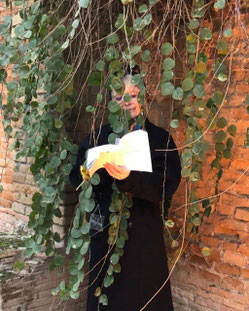
Rome returns again and again, not as a monument, but as a hinge: between Sweden, Paris, Trastevere, Bosco Parrasio; between poetry, alchemy, science and spirituality; between past and present – and beyond. Figures like Queen Christina linger in the background, embodying triangulation, exile, intellectual freedom and spiritual exploration. History is not reconstructed but approached obliquely, through gestures, objects, poems read from a bench rather than a podium.
What emerges from the interview is not a clear definition of art, but perhaps its opposite. Art as something that happens when explanations fail. When language runs out. When emptiness is carefully protected. “Everything is normal,” the artist says, “because nothing is normal.” Returning to Rome, returning to Circolo, is not about repetition or progress. It’s about entering, once again, an indescribable space that only opens through trust, shared attention, and time. An exact space however, where work does not demand justification, where
refusal becomes a method, and where consciously being there is already enough.
In the end, the interview circles back to the simplest, hardest question: What are we doing here? There is no answer, and that, it seems, is exactly the point.
Text: Gabriele Valente
Photo: "Bosco Parasio, poème à louer" © CRB 2026, John Sundkvist © 2026