
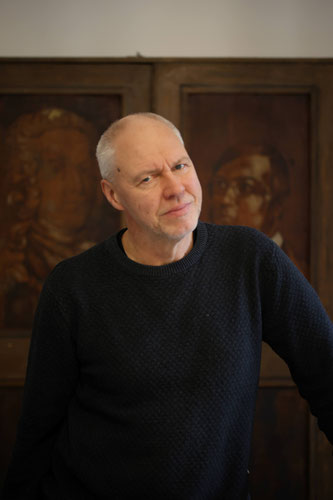
Arto Kivimäki from Finland spent November and December at Circolo Scandinavo. For Arto, being in Rome makes you experience different time layers, and enables travels back and forth in time. Arto is a free translator and throughout his working life, he has translated several Roman poets, such as Plautus, Plinius and Propertius. His interest about ancient literature started early, and has continued to amaze him ever since.
‘When I was very young, I read French and Belgian comics, Asterix and so on, they became very popular at the time and I loved them. But also, when I was in my teens, I read a lot of literature and a lot of old literature. I read about ancient philosophy and I was so amazed. I loved their way of thinking and seeing differently. And I thought that if you study Latin you can read good philosophy… It was too late when I noticed that it is the Greek literature that is actually interesting’
Talking to Arto is like opening a book to a different world in a different time. As his profession lies in classical studies, Rome is the place to be. Here you find some of the oldest Latin literature that has survived to us such as Plautus, a Roman playwright. His plays have influenced both Molière and Shakespeare, and the first manuscript was printed only 10 years after the Gutenberg Bible. Many Roman playwrights, presumably including Plautus, lived on the Aventine hill, and the writer’s guild was also located there, only a stone’s throw from the Circolo. The wings of history can at times be striking, knowing that the ancient poets and playwriters walked the same streets as us.
Arto’s current project involves translating one work of Propertius, who lived during the short Augustan love elegy period. Translating classical poetry differs a lot from modern poetry. It is a lot of investigation work involved, as it is not always clear what the original manuscript says. In Finland, classical studies is a small field, and few translations have been made. The access to corresponding literature, which can help the translator understand the essence of the text, is limited. To only translate is not enough, you have to really understand the meaning behind the text to enhance the small shifts, like irony or mockery.
Arto grew up in Joensuu in Northen Karelia, eastern Finland. Even though Arto is now based in Helsinki, he explains that Karelia never leaves you. Arto can draw parallels between the Western and Eastern Finland vs the Greek and the Romans during the antique. Finland has the largest genetical glide in Europe between the east and the west, and the cultures differ a lot. In Plautus' texts, there is a verb ‘to Greek’ (graecari), meaning to live the lush life, filled with parties, dance and joyful dinners. Arto can see the resemblance of comparing the different cultures within Finland to how the Romans and the Greek explained and compared each other.
At Circolo Scandinavo things differs from other international institutes. Arto has been a resident several times at the Finnish institute in Rome and he finds Circolo Scandinavo interesting that it is a space mainly for artists, as well as a place where different cultures meet. When Nordics people meet you first think that they are similar. Yet once you start digging deeper, there are differences between the Nordic cultures. Circolo is therefore a unique space, where these cultural differences can be explored, yet also a space where different art can meet.
‘It becomes a cultural boiling pot here at Circolo. But also, it becomes layers between the different kinds of art, from the artists own point of view of their art field, like visual art, literature, and classics, like as I am from.’
Written by: Sara Rynefors
Photo: Sara Rynefors